
Martin County Court Records After Arrest
After a Martin County arrest, the jail roster and the court record answer different questions. The Martin County Jail roster is a custody report from the Sheriff's Office. It can show the booking date, arresting agency, charge text, status, projected release date, and bond amount for a person held at Martin County Jail. The formal court record begins after the Martin County Attorney's Office files a complaint, petition, citation, or other charging paper in Martin County District Court.
The Martin County Attorney's Office is the chief prosecutor for adult crimes and juvenile offenses committed in Martin County. It also handles petty misdemeanor, misdemeanor, and some gross misdemeanor prosecution for Ceylon, Dunnell, Fairmont, Granada, Sherburn/Welcome, Trimont, and Truman under local contracts. For custody and booking detail, use Martin County jail inmate records. For booking photos and photo requests, use the separate Martin County jail mugshots page. Court records after a jail arrest focus on charges, hearings, orders, and outcomes.
The official criminal prosecution process says law enforcement may issue a citation, make an arrest, or forward a case for prosecutor review. If the prosecutor finds probable cause, a petition or complaint is filed in District Court. That filing is the point where the arrest becomes a court case that can be searched through Minnesota Court Records Online.
Find Martin County Court Records
Minnesota Court Records Online, called MCRO, is the main public portal for Martin County court records after an arrest. The MCRO Case Search can be searched by name, case number, citation number, or attorney. Court Location can be set to Martin County when the search needs local criminal and traffic records instead of a statewide sweep. Newly filed cases may be easier to find by case number if a name search does not return the pending file.
The Minnesota Judicial Branch MCRO overview says MCRO is not the official court record and is not a background-check system. Certified copies come from court administration. Some public records that can be viewed at a courthouse are not available remotely. Pending criminal, traffic, and petty misdemeanor cases without a conviction may not return by defendant-name search, but a case-number search can still work when the number is known.
The official MCRO search screen is shown in the Minnesota Court Records Online Case Search source page.
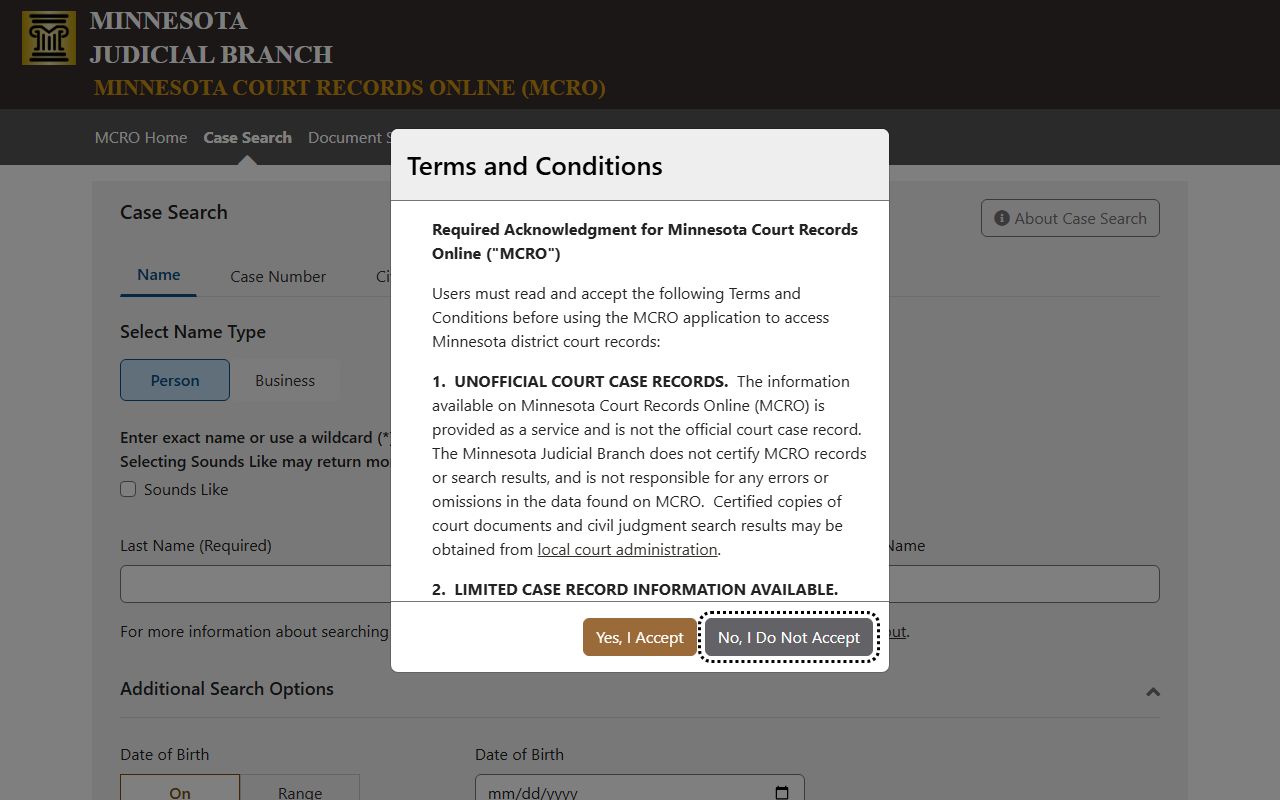
Use the MCRO tabs to separate case lookup from document, hearing, and judgment searches when reading a Martin County court record after a jail arrest.
| MCRO Field | Type | Required | How It Helps |
|---|---|---|---|
| Search tab | Tab | Yes | Choose Case Search, Document Search, Hearing Search, or Judgment Search. |
| Case Search method | Option | Yes | Name, case number, citation number, and attorney searches are available. |
| Last Name | Text | Conditional | Use exact spelling, a wildcard after two characters, or Sounds Like without wildcards. |
| First Name | Text | Optional | Narrows a person-name search for common names. |
| Date of Birth | Date | Optional | Helps separate people with the same or similar names. |
| Court Location | Filter | Optional | Select Martin County when the arrest and filing are local. |
| Case Number | Text | Conditional | Best path for pending cases that do not appear by defendant name. |
Search After a Jail Arrest
A practical court-record search starts with the custody record, then moves to the court case. The jail roster can supply the exact name, booking date, arresting agency, and charge wording. MCRO can then show filed charges, hearing events, documents that are available remotely, and the Register of Actions, which is the chronological event list for the case.
- Open the current Martin County Jail roster and note the name, booking date, arresting agency, status, and charge wording.
- Search MCRO by defendant name, with Court Location narrowed to Martin County when the arrest is local.
- If the name search fails, try a case number or citation number when one is available from court papers, a citation, or court administration.
- Read the Register of Actions and charge list. Check whether charges were amended, dismissed, reduced, or resolved by plea or verdict.
- Use the public court calendar as a hearing clue, but do not treat absence from the calendar as proof that no court case exists.
For public conviction history, the Minnesota BCA Public Criminal History Search is a separate system. BCA data is based on criminal-history records and fingerprints, while MCRO is the court case-access portal. That distinction matters because a jail booking charge, a filed court charge, and a final conviction can all be different.
Martin County Court and Prosecutor
Martin County District Court is located at 201 Lake Avenue in Fairmont. Court Administration can be reached at 507-432-7003, and the listed business hours are Monday-Friday, 8:00 a.m. to 5:00 p.m. Court Administrator Catherine Celander is named on the Minnesota Judicial Branch court page. The court has original jurisdiction over criminal, traffic, juvenile, civil, family, probate, and other cases filed in Martin County.
The District Court page states that the public court calendar is posted at 7:00 a.m. each business day and updated hourly. Calendars do not include every matter handled by the court, and confidential or non-remote matters are not posted. For certified copies, older court records, or a record that MCRO does not make available remotely, Martin County District Court Administration is the correct court contact.
The local District Court details appear on the official Martin County District Court source page.
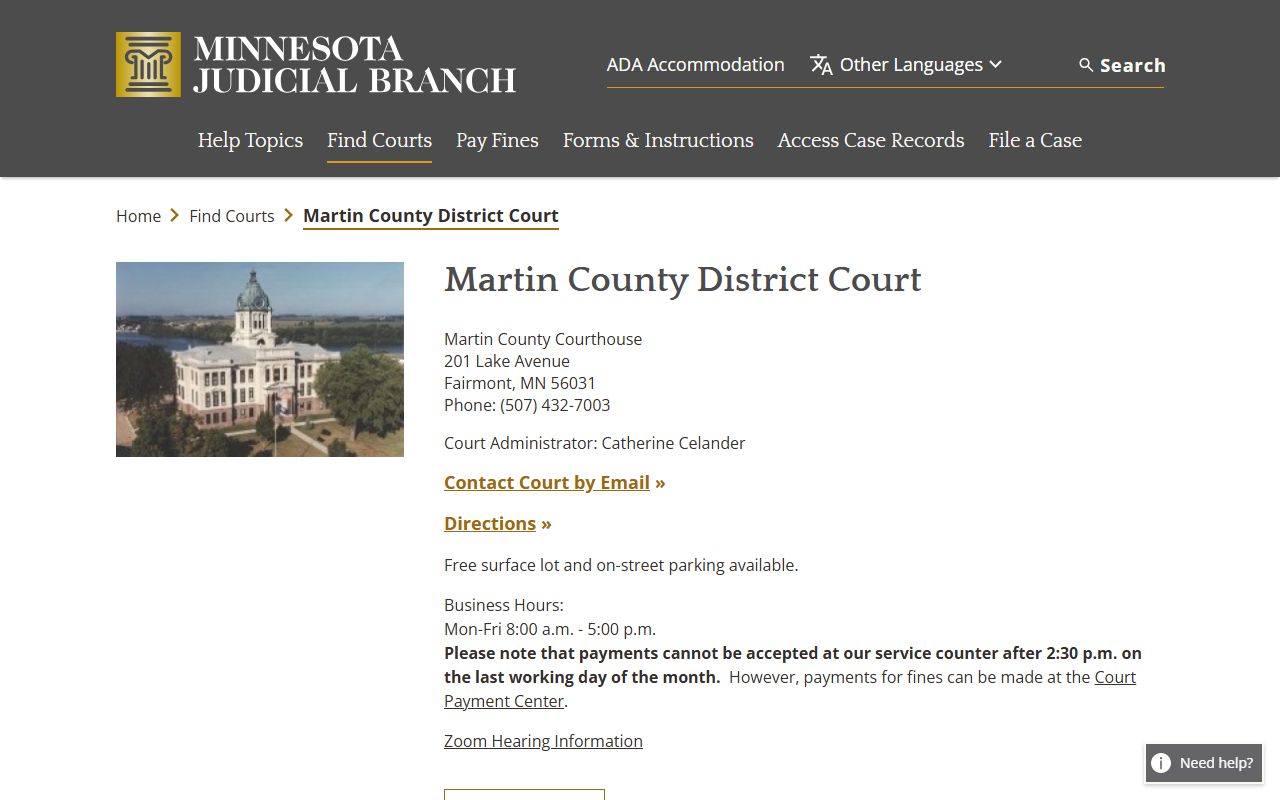
Those court details are useful after a Martin County jail arrest when MCRO does not show the needed document or certified copy option.
Martin County District Court
201 Lake Avenue
Fairmont, MN 56031
507-432-7003
Monday-Friday, 8:00 a.m.-5:00 p.m.
Martin County Attorney
123 Downtown Plaza
Fairmont, MN 56031
507-238-1594
county.attorney@martincountymn.gov
Minnesota uses county attorneys rather than district attorneys. Martin County Attorney Taylor L. McGowan is listed as County Attorney, with Assistant County Attorneys Amanda L. Heinrichs-Milburn and Suelana Kinney. The office does not investigate crimes and cannot give private legal advice to citizens. Crime reports must go to the law-enforcement agency where the incident occurred.
Charging Documents After Arrest
Charging documents are the bridge between the jail arrest and the court record. The Martin County Attorney's process page describes probable cause as the charging standard: facts must support that a specific defendant committed a specific crime on a specific date in the county. A complaint or petition filed in District Court is not the same as proof of guilt. It is the prosecutor's formal accusation that starts the court track.
| Document | Used For | What to Read |
|---|---|---|
| Complaint | Common criminal charging paper filed by the prosecutor. | Alleged facts, offense counts, dates, venue, and probable-cause statement. |
| Petition | Juvenile matters and certain prosecutor filings. | Allegations, requested court action, and case category. |
| Citation | Traffic, petty misdemeanor, and some misdemeanor matters. | Offense label, citation number, court date, and issuing agency. |
Misdemeanor cases may move through arraignment, pretrial, trial, and sentencing. Gross misdemeanor and felony cases usually include a Rule 5 first appearance, Rule 8 second appearance, omnibus or pretrial hearing, possible contested omnibus or Rasmussen hearing, trial, and sentencing. Each step can add orders or events to the Martin County court record after arrest.
Martin County Charge Status
Charge status can change after a person is booked. A jail roster entry may use short status labels such as Pending, Bail Set, Sentenced, or Case Dismiss/NG. MCRO and court documents may later show an amended complaint, a dismissed count, a plea, a verdict, or a sentence. Always read the most recent court event and the disposition for each count.
| Status | Meaning in a Court Record |
|---|---|
| Pending | The case or count is still open, and no final disposition is shown for that charge. |
| Amended | The prosecutor changed a count, wording, severity level, or filed charge list. |
| Dismissed | The count or case was dropped by court order or prosecutor action. |
| Convicted | A guilty plea, verdict, or accepted admission created a conviction on that count. |
| Sentenced | The court imposed jail, probation, fine, prison, or other sentence terms. |
Bond, Warrants, and Holds
Martin County's public roster includes a Bond Amount column, but the listed amount may not tell the full release story. Minnesota Rule of Criminal Procedure 6 governs pretrial release and generally favors personal recognizance or unsecured appearance bond unless public safety or court appearance concerns require more conditions. If money bail is imposed, money bail must be available as a release path without other conditions.
| Release Term | Plain Meaning |
|---|---|
| Personal recognizance | Release based on a promise to appear, with no cash paid up front. |
| Unsecured bond | A dollar amount may be owed only if release terms are violated. |
| Cash bail or bond | Money is paid to secure release and future court appearance. |
| No-bond hold | Payment alone will not release the person because a court order, warrant, detainer, or agency hold blocks release. |
The Martin County active warrant page is an official warrant-list channel, not a live warrant search form. It says the list is updated biweekly, warns the public not to confront wanted people, and states that warrants must be confirmed by the issuing agency before action. Warrant tips and confirmation questions route to 507-238-4481 or the nearest law-enforcement agency.
Charges Versus Convictions
A charge is an accusation. A conviction is the result of a guilty plea, guilty verdict, or other finding accepted by the court. The Martin County Attorney's prosecution material uses probable cause for charging, while conviction requires proof beyond a reasonable doubt. That gap is why a Martin County court record after arrest must be read by count and by final disposition.
| Point | Charge | Conviction |
|---|---|---|
| Stage | Filed near the start of the case. | Appears after plea, verdict, or qualifying adjudication. |
| Standard | Probable cause. | Proof beyond a reasonable doubt. |
| Meaning | An accusation that may change or be dismissed. | A final result for a count unless later changed by court action. |
| Best source | Complaint, citation, petition, and MCRO charge list. | Disposition, sentence, BCA conviction history, and certified court record. |
Sealed and Expunged Records
Minnesota expungement means a record is sealed from ordinary public view. It does not always mean each agency copy is destroyed, and it does not guarantee that every private copy disappears. The Minnesota Judicial Branch criminal expungement page explains the court process. Minnesota Statutes section 609A.015 also provides automatic expungement eligibility for certain dismissed, resolved-in-favor, diversion, stay, and qualifying conviction records.
| Point | Sealed | Expunged |
|---|---|---|
| Public view | Hidden from ordinary public access when the order applies. | Also sealed in the practical Minnesota court-record sense. |
| Agency access | Certain agencies may still have limited access under law. | Access depends on the statute and order. |
| Trigger | Court order or automatic statutory process. | Court order or automatic statutory process. |
| Limits | Does not prove third-party copies were removed. | Does not promise jail, BCA, court, and private copies all vanish at once. |
Minnesota Statutes section 13.82 makes law-enforcement arrest data public at the originating agency, while section 13.85 protects some corrections and detention data. Juvenile matters, active investigations, protected addresses, public civil-commitment documents, OFP and HRO material, and other restricted data may be limited in MCRO or withheld remotely.